
Leadership and the Dark Side:
An unresolved paradox
By Paul Barrett & Maretha Prinsloo
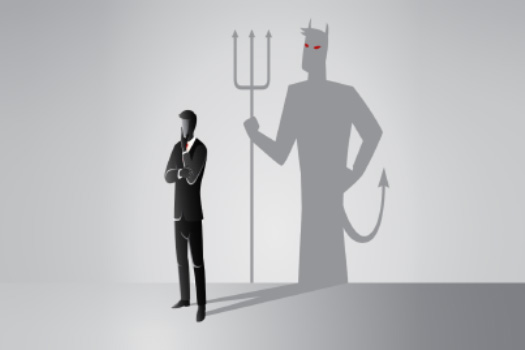
The Dark Side
For recruitment and selection of individuals for leadership roles in organizations, whether as leadership-role entrants through to chief executives, the majority will use some variant of a “Dark Side” personality assessment along with one assessing more neutral or positive personality attributes.
A recent paper by Robert Hogan and colleagues entitled: “Twenty years on the Dark Side: Six lessons about bad leadership” defines the concept first identified and presented to HR and workplace recruiters over 20 years ago by Robert and Joyce Hogan and operationalised as an assessment in the now famous Hogan Development Survey (HDS).
“The first lesson, and the major thrust of the original article (Hogan & Hogan, 2001), is the need to distinguish between the bright and dark sides of personality.1 The bright side refers to peoples’ behavior when they are paying attention to how they impact their audience. The FFM is a taxonomy of bright-side tendencies and subsumes the characteristics assessed by most common inventories. Bright-side tendencies concern desirable social performance—being poised, interpersonally effective, creative, trustworthy, or organized—characteristics that facilitate an individual’s ability to get along and get ahead.
In contrast, the dark side of personality concerns counterproductive tendencies that emerge when people are stressed, distracted, or simply unconcerned about the impression they are making—for example, when managers interact with their subordinates as opposed to upper management. These tendencies differ from bright-side tendencies in that they are less frequently observed yet are both more extreme and more complicated in their implications for performance.” (p. 201-202)
Almost every major self-report psychometrics questionnaire vendor now has a ‘Dark Side’ questionnaire in their product line. Podium365 being the latest, launching their “Derailers” questionnaire.
The Dirty Dozen
In 2010, Peter Jonason and Gregory Webster introduced the Dirty Dozen self-report questionnaire, as a concise, 12-item assessment of what Delroy Paulhus and Kevin Williams in 2002 had earlier defined as the Dark Triad; a term used to describe a constellation of three socially undesirable personality traits: Narcissism, Psychopathy, and Machiavellianism. The 12 items can be viewed in an online mindtools.com article
The Paradox Explained
The concept of a Dark Side is so very appealing. It made sense in 2002 and still does. The attribute names alone, let alone behaviours of those scoring ‘high’ on these dark side personality attributes say it all. It’s why the term ‘derailer’ was used extensively to characterise such people.
These are the people whose behaviours will sabotage an organization as their dysfunctional behaviours negatively impact organizational goals and ultimately disrupt its workforce. Hence, organizations worldwide reached for an HDS or an equivalent from their favourite assessment provider or slipped in a 12-item Dark Triad questionnaire to use as a ‘screen-out’ assessment. They might even have used the test scores as a guide to assist in their subjective appraisal of the risk involved in employing high-scorers.
The problem is none of this has worked as we have been led to expect.
In fact, little has changed over the years in terms of the qualities and behaviours of those appointed to leadership positions around the world. Psychologists, HR, management consultants and recruiters have tried to promote a ‘you know it makes sense’ message with all kinds of “warning: derailer at work’ examples to buttress their reasoning. But, as the abstract of a recent paper states:
“Recently there has been a burgeoning literature on leaders who exhibit grandiose narcissism, Machiavellianism, and manifestations of psychopathology. Two important findings are that these “dark-triad” leaders are reasonably common because the traits predict leader emergence, and that the traits are associated with harm for organizations and their members. The juxtaposition of commonality and harm seemingly challenges assumptions about performance-enhancing organizational adaptations and begs the obvious question of why and how psychologically toxic individuals can rise to and remain in powerful positions. I argue that labels applied to leaders implying darkness or dysfunction divert attention in unproductive ways from the benefits of these traits and bias research findings. I present arguments as to why many people readily choose what research suggests are psychologically problematic people to follow. Fixing the many leadership crises besetting modern societies requires more attention to why people rise to positions of power and, more controversially, teaching people to embrace, rather than shun, behaviors and tactics that actually create power and career success. If power is to be used for good, good people need to know and willingly use the tools of power, even if, or possibly particularly if, such tactics are also used by their opposites.” (Jeffrey Pfeffer, 2021)
This is the ‘thinking person’, evidence-based antidote to all those who promote the simplistic message that the Dark Side of personality is dysfunctional and ultimately pathological. The logic, empirical evidence, and reasoning in this article is crystal clear.
The Dark Side attributes used to screen-out candidates are also screening out the very attributes which contribute to successful leadership. It’s a serious paradox caused in part by psychologists and consultants making value judgements about attribute magnitudes in isolation of circumstances, time-perspectives, and the attributes people need to succeed in any competitive business, organizational, institutional, or political environment.
As Pfeffer concludes:
“Most fundamentally, traits that are putatively deviant or maladaptive turn out to be reasonably common among leaders and predictive of career success as assessed along multiple dimensions. Second, because many of the so-called dark triad traits and behaviors either signal or create power – or both – and because people are attracted to power and status and want to be close to it for many reasons, it turns out that many individuals will willingly, voluntarily sign up to work for and by lead by “bad” leaders. What seems “bad” or “dark” to some social scientists, therefore, is common, sometimes produces success, and often attracts numerous followers in the organizational and political world …
It is far from clear to me that either leadership science or practice has been well-served by dark terminology and value-laden research, both of which have tended to cloud the observation of empirical regularities and to expending enormous effort to find what the values dictate as desirable. As I have previously noted (Pfeffer, 2016), the field of leadership is too much filled with lay preaching. This fact may explain why decades of research has failed to improve leaders, leadership practice, or to remediate leadership shortages. Nor is there much if any evidence that focusing on the dark triad or its constituent elements has caused them to be less prevalent in the world or to attract fewer followers. When a particular approach fails to work for a long time, maybe it is time to change the approach, alter judgments, and reconceptualize labels, research, and teaching.” (p. 548)
A Question Arises
If many are now using a self-report questionnaire to help screen out ‘undesirable high-scoring Dark Side candidates’ as part of any recruitment-selection process, how can it be that little of any obvious consequence has changed?
Apart from the subjectivity likely being applied in the use of any such assessment scores, another reason is ATIC – a candidate’s Ability To Identify Criteria. As the authors (Kleinman at al, 2011) state in the abstract to their article:
“Personnel selection procedures such as assessment centers, structured interviews, and personality inventories are useful predictors of candidates’ job performance. In addition to existing explanations for their criterion-related validity, we suggest that candidates’ ability to identify the criteria used to evaluate their performance during a selection procedure contributes to the criterion-related validity of these procedures. Conceptually, the ability to identify criteria can be framed in the broader literature on peoples’ ability to read situational cues. We draw on both theory and empirical research to outline the potential this ability has to account for selection results and job performance outcomes.”
So, perceptive and manipulative leadership candidates can interpret self-report assessment items in the context of the criteria of the job-role (and the organization itself) and produce the kinds of responses that are adjudged ‘reasonable’ and are likely to pass scrutiny by algorithm or assessor; and when questioned post-assessment, might well invoke some of their other Dark Side attributes to enhance their image of confidence and ‘leadership potential’.
We have got this all wrong by focusing on the assessment psychometrics rather than the psychosocial realities of what’s being assessed, even though some authors (Tett & Simonet (2021) for example) still keep arguing that this is purely a ‘psychometrics’ problem.
So how might we look at this issue afresh?
Let’s start with Pfeffer’s closing sentence to his article:
“When a particular approach fails to work for a long time, maybe it is time to change the approach, alter judgments, and reconceptualize labels, research, and teaching” (p.548)
Therefore, as human resources and organisational development professionals, are we on-target in trying to focus our attention on “who are the bad guys” or can our lenses be widened?
It may make more sense to calibrate current psychometric practices in terms of the professional purposes of HR and OD practitioners. We might describe this calibration as:
- facilitating an ever-emerging understanding of the organisation’s contextual challenges
- architecting diverse, integrated, and agile organisational morphologies as “market-oriented ecosystems” (as suggested by Dave Ulrich)
- contributing to strategic agility and innovation in the face of constant social, digital and environmental changes
- managing and inspiring talent and collaboration to create a culture of proficiency by which to ensure organisational sustainability.
Talent management and leadership succession are key to all these considerations as organisations are aimed at creating value through people and purpose.
But how do we identify and grow talent and leadership? The current trend is to screen out potentially risky candidates according to culturally-based expectations. Such an arbitrary strategy may of course result in the desired effects at times, but often for the wrong reason because:
- “dark” personality characteristics may be indicative of low levels of awareness; this follows from what Ken Wilber stated in 1993:“the entire spectrum of consciousness development is characterised by a decline in egocentrism”. But even lower levels of awareness than those associate with “darkness”, may not be associated with the “dark” characteristics at all
- “dark” characteristics may be culturally triggered and/or indicate contextual coping mechanisms which may be socially expected or respected as well as effective
- “dark” characteristics may just be (consciously or unconsciously) leveraged for effect
- according to Mindell’s Jungian based Process Oriented Psychology, unconscious and unintentional verbalisations, and behaviours with which the individual does not identify, may emerge in social contexts or “dreaming fields” where powerful roles arise due to systems dynamics
- in the case of self-report personality or emotional intelligence questionnaires, containing transparent item content, candidates capable of critical introspection, and/or who tend to respond in an honest way to socially undesirable item content, normally achieve higher scores on the “dark” characteristics than those who are in denial and/or try to manipulate the test results to create a socially desirable profile.
It follows that personality characteristics, including the “dark” traits, can be largely regarded as symptoms of levels of consciousness / awareness, worldviews, coping strategies or collective processes. They may be both effective and ineffective in a leadership role and/or in terms of making sustainable contributions.
Therefore, the assessment of leadership characteristics should focus on the measurement of the root causes of behaviour, or the levels of awareness /consciousness of the person, their worldviews, perceptual and decision-making frameworks, motivational drivers as well as their cultural orientations and valuing systems.
But not only consciousness, values and motivation are important in the identification and leverage of leadership; the cognitive capacity to apply systems thinking in dealing with vague, dynamic, and complex systems, is also critical.
In unfamiliar, vague/ambiguous, and dynamic environments, leaders with excellent interpersonal skills may completely fail without the cognitive capacity to manage high levels of complexity. On the other hand, someone with definite “dark” personality traits but who shows the appropriate level of awareness and cognitive capacity, may be able to push through sustainable decisions – even though sometimes to the detriment of others.
Sustainable strategy formulation and decision-making capability are thus heavily rooted in both consciousness as well as in intellectual prowess, interest, curiosity and learning agility.
In Conclusion
For purposes of leadership assessment, potential leadership candidates thus have to be evaluated in terms of their:
- worldview, perceptual and decision-making frameworks, level of consciousness and awareness and valuing systems, as well as their
- energy and motivational drive and
- information processing capacity and energy to deal with complexity and learn quickly.
Cognadev offers the Value Orientations (VO), the Jungian-based Motivational Profile (MP) and Cognitive Process Profile (CPP) assessments in this regard. These measurements fundamentally differ from current Psychometric practices aimed at ability testing and personality results indicating behavioural traits and derailers of performance.
Note:
For those wanting more detail of what Pfeffer says, we’ve created a web-based slide-deck providing a summary of his thesis.
References
Hogan, R., & Hogan, J. (2001). Assessing leadership: A view from the dark side. International Journal of Selection and Assessment, 9(1 & 2), 40–51. https://doi.org/10.1111/1468-2389.00162
Hogan, R., Kaiser, R.B., Sherman, R.A., & Harms, P.D. (2021). Twenty years on the dark side: Six lessons about bad leadership. Consulting Psychology Journal: Practice and Research, 73, 3, 199-213. https://dx.doi.org/10.1037/cpb0000205
Jonason, P.K., & Webster, G.D. (2010). The dirty dozen: A concise measure of the dark triad. Psychological Assessment, 22, 2, 420-432. https://doi.org/10.1037/a0019265
Kleinmann, M., Ingold, P.V., Lievens, F., Jansen, A., Melchers, K.G., & König, C.J. (2011). A different look at why selection procedures work : The role of candidates’ ability to identify criteria. Organizational Psychology Review, 1, 2, 128-146. https://doi.org/10.1177/2041386610387000
Paulhus, D. L., & Williams, K. M. (2002). The dark triad of personality: Narcissism, Machiavellianism, and psychopathy. Journal of Research in Personality,36, 556–563. https://doi.org/10.1016/S0092-6566(02)00505-6
Pfeffer, J. (2021). The dark triad may be not so dark: Exploring why ‘toxic’ leaders are so common-with some implications for scholarship and education. Psychoanalytic Inquiry, 41, 7, 540-551. https://dx.doi.org/10.1080/07351690.2021.1971470
Tett, R.P., & Simonet, D.V. (2021). Applicant faking on personality tests: Good or bad and why should we care? Personnel Assessment and Decisions, 7, 1, #2, 1-15. https://doi.org/10.25035/pad.2021.01.002
Wilbur, K. (1993). The spectrum of consciousness. Wheaton, Illinois: Quest Books.