

Cognadev’s Value Orientations compared with Schwartz, O*NET, Hogan, and other discrete-score models
By Cognadev
Most psychologists and assessment publishers who work with values have adopted the familiar psychometric-category descriptive approach, constructing discrete sum-score scales of ‘value magnitude’ generated via descriptive statistical analysis of self-report Likert- type item scales; producing taxonomies of ‘values’ (or motivations) that are similar to the usual sum-score trait models of personality e.g., Saville WAVE SHL OPQ, Big Five, HPI etc.
An exception is Richard Barrett’s Personal Values Assessment, which has evolved over time into a more formal 7-levels of consciousness model based upon Don Beck’s Spiral Dynamics (levels of consciousness), integrated with Barrett’s own seven levels of consciousness model and Ken Wilber’s four Quadrants.
Another is Shalom Schwartz’s revised theory of basic values. From the abstract to the article (Schwartz et al, 2012):
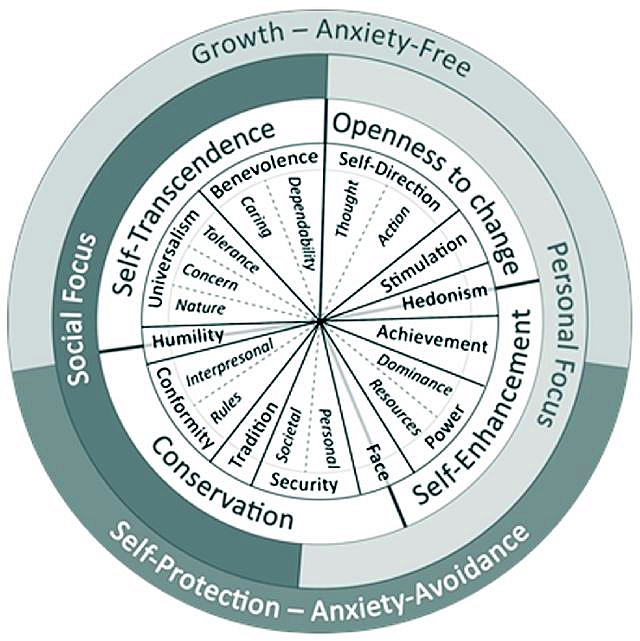
“Values form a circular motivational continuum. The theory defines and orders 19 values on the continuum based on their compatible and conflicting motivations, expression of self-protection versus growth, and personal versus social focus”.
In Figure 1, we show the Schwartz 19-value model representation (reprinted from Rajiani & Kot, 2019):
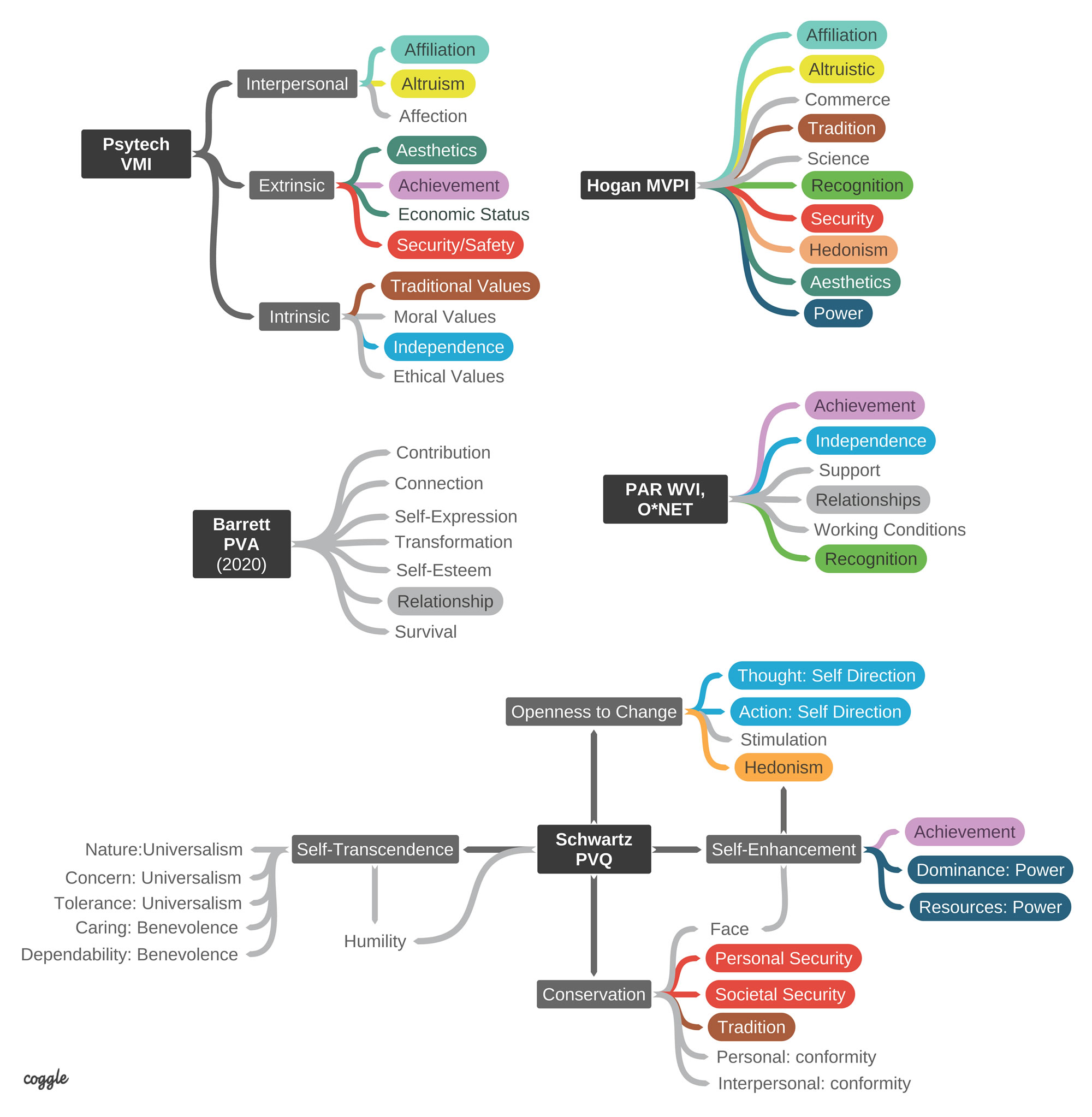
In Figure 2, we show the discrete values/constructs assessed within a selection of the various assessments which are advertised as assessing values or have the word “values” in their title.
Note:
Those values with scale names in-common to two or more questionnaires are color-coded accordingly. Values in light-grey are unique to a particular questionnaire.
- Abbreviations
- Psytech VMI: Psytech International, Values & Motives Inventory
- Hogan MVPI: Hogan Assessments, Motives, Values, Preferences Inventory
- Schwartz PVQ: Schwartz Portrait Value Questionnaire (Revised)
- Barrett PVA: Barrett Personal Values Assessment (revised 2020 model names)
- PAR Inc. WVI: Messer & Greene’s Work Values Inventory (O*NET Work Values)
Values as Categories vs Value Systems/Orientations
The one distinguishing feature all of the assessments/models in Figure 2 is that values are treated as discrete ‘entities’ or categories on which a person possesses some kind of magnitude. Although the Barrett model is advertized as a “levels of consciousness” model,the PVA attributes still look and sound like categorical attributes. The same with Schwartz’s circular model. Whichever way you look at these, in practice you end up interpreting the values as ‘categorical’ features. The Hogan, Psytech, and O*NET assessments are explicitly categorical. That is why these assessments look no different in many respects from the static, sterile, descriptive taxonomies of most personality assessments. And that is the huge difference between assessing values as categories and, as Cognadev approaches these issues, values as ‘systems’ or orientations.
Cognadev’s assessment of value orientations, or levels of consciousness, is based on the work of Dr. Clare Graves. His comprehensive Spiral Dynamics (SD) model of “biopsychosocial systems development” (also referred to as the Emergent Cyclical Levels of Existence Theory (ECLET)) can be represented as a spiral of various hierarchically organized levels of human existence. According to Graves:
“The psychology of the mature human being is an unfolding, emergent, oscillating, spiraling process marked by progressive subordination of older, lower-order behavior systems to newer, higher-order systems as man’s existential problems change.”
The various valuing systems otherwise referred to as worldviews, organizing frameworks, belief structures, mindsets, perceptual filters, memes, or decision-making frames, represent a continuously unfolding spectrum of consciousness and awareness. Each increasingly inclusive, consecutive sub-system or value orientation, integrates and transcends previous valuing systems. The entire Spiral Dynamics (SD) spectrum involves a soft and dynamic hierarchy or “holon”. The seven SD levels assessed by Cognadev’s Value Orientations (VO) assessment are shown in Figure 3.
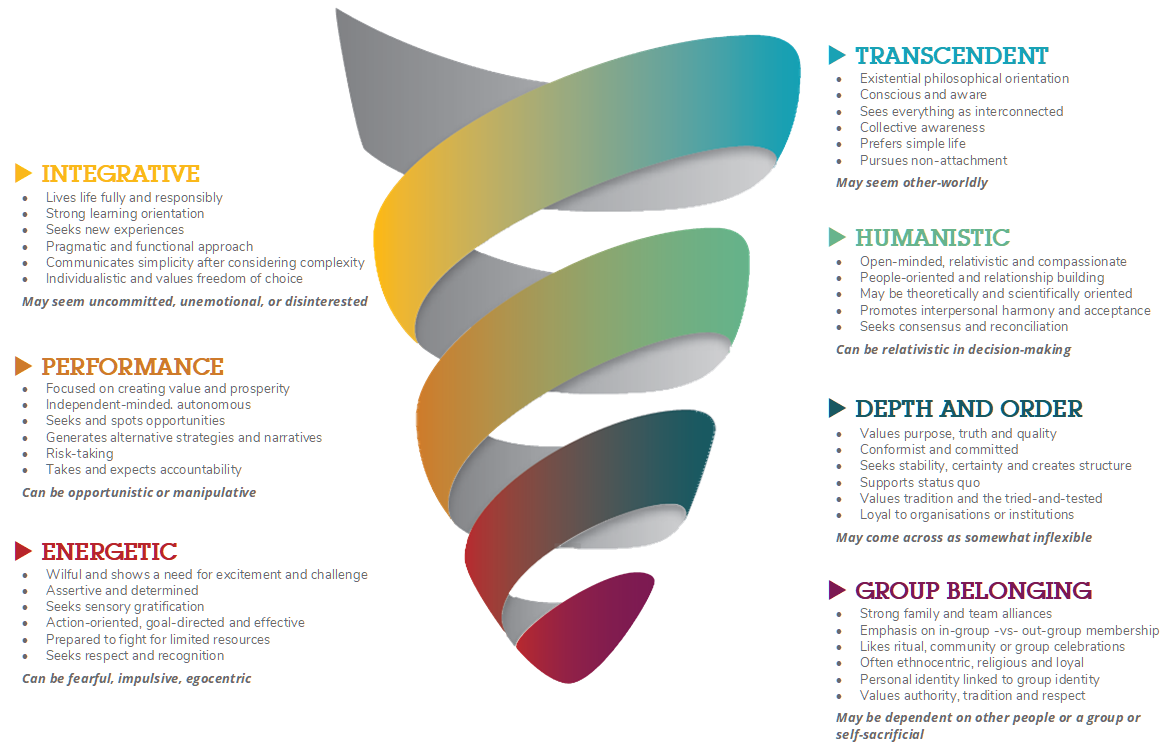
Each of the value orientations of the SD model forms complex systems of behaviour, beliefs, attitudes, perceptions, and thoughts.
Valuing systems act as catalysts in determining how people can be expected to apply their intellect, talents, and personality. Instead of describing a person’s values as traits or characteristics, value orientations as identified by the VO predict a wide range of psychological and behavioural factors, developmental options, defence mechanisms and cultural dispositions across contexts.
By understanding a person’s value orientation, one is likely to predict those in the workplace who are best suited to challenges such as:
- doing routine work in a team context
- relentlessly pursuing goals under difficult circumstances
- maintaining the status quo by ensuring quality and controlling risk in a reliable and structured manner
- showing a customer orientation
- flexibly generating new strategies and persuasively creating value for all stakeholders
- building relationships
- developing others and creating harmony at work
- integrating and understanding the dynamics of the whole system to identity the leverage necessary to initiate change.
The SD model thus offers practical utility within the context of talent management.
Now you see why the VO is so powerful when used in the workplace. This is not the simple attribute profile stuff of other ‘values’ assessments but a truly deep assessment of how a person’s cognitive system is construing work, people, events, personal goals, and their preferences/orientations toward thinking/valuing these things.
As with all Cognadev assessments, we don’t just scratch the surface but aim to understand the complexity of human functioning from an integrative systems perspective.