

What is the Information Processing Model (IPM)?
Part 1 of 4
By Maretha Prinsloo
A theoretical model for the assessment of cognitive complexity
In 1992, Maretha Prinsloo used a cognitive perspective to analyse the way in which people deal with everyday challenges, including work complexity, to develop the Information Processing Model (IPM). The IPM is a self-contained, holonic representation of the cognitive processes involved in the meaningful and purposeful conceptualisation of information. The model identifies interactive, functional categories of cognitive processing as well as the metacognitive criteria by which own thought processes are guided, monitored, controlled and corrected in a self-aware way.
The IPM forms the basis of Prinsloo’s thinking process simulations aimed at assessing cognitive functioning. The specific simulations involved, namely the Cognitive Process Profile (CPP) and the Learning Orientation Index (LOI), measure the cognitive preferences and capabilities or the cognitive complexity and learning potential of individuals as required for effective functioning in job roles at various levels of work complexity.
Functional processing categories
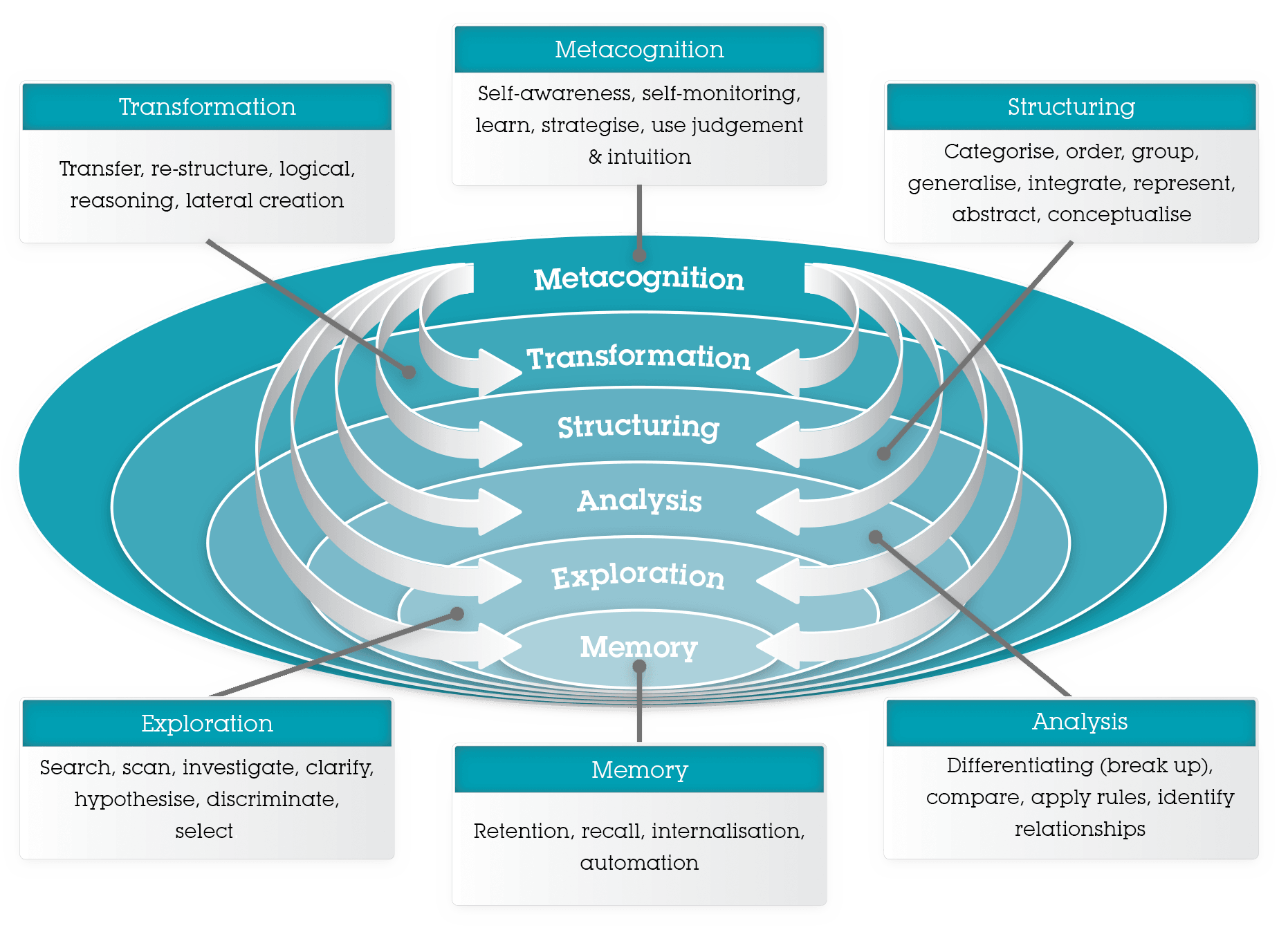
The IPM represents thinking processes holonically, which means that higher level processes incorporate aspects of the preceding levels while also transcending them. The broad functional processing categories include Memory, Exploration, Analysis, Structuring and Transformation. These processes each consist of many processing subcomponents, some of which can also be applied in other processing categories, but for different functional purposes.
Metacognitive criteria or guidelines
The application of each of the above functional processing categories is guided and controlled in terms of certain internalised metacognitive criteria or guidelines for effective processing. For example, the criteria given for Exploration are “Relevance”, “Clarity” and “Depth”. When solving a problem, these criteria may cause a person to ask themselves questions, such as:
- What information is important here and what is irrelevant?
- Do I understand this issue and is it clear to me? What don’t I understand?
- Do I need more information to understand the issue? Do I need to investigate it further?
The metacognitive criteria involved in guiding thinking processes are graphically represented below.
How to think
Every day we are faced with a multitude of problems. Deciding what to wear to work, navigating the traffic and reading a paper presents us with many mental challenges:
- How should I dress for that important meeting?
- Should I turn left or right?
- What does that word mean in this sentence?
And when we get to work, whether you are a bricklayer, a clerk or a business analyst, there are more problems that need to be solved:
- Am I still laying the bricks level?
- How much change do I need to give?
- Does my model capture the problem effectively?
A great deal of our mental activity revolves around solving a variety of problems that have different levels of complexity. We cannot avoid problems as they will find us on our days off, during our holidays and in all forms of work and even play. We have the power to change how we face these problems and how effectively we solve them. While personality can make a difference, here we will be focusing on how people think through and conceptualise issues.
How people think
Maretha Prinsloo’s holonic model of thinking processes offers a perspective on how cognition works. Holons consist of embedded systems that increase in complexity. They can be described as evolving, self-organising, soft hierarchies where subsequent systems include and transcend previous systems.
A nice example of a holon is how living cells eventually form a society. Cells are systems, but cells are included and transcended by organs. Organs are included and transcended by organisms, which are included and transcended by societies. In fact, the universe primarily consists of interrelated holons, which are maintained by a constant exchange of matter, energy and information.
Thinking processes and the way they are applied reflect a holonic structure. Memory is the foundation and enables other thinking processes. Memory is included and transcended by other systems of increasing complexity: Exploration, Analysis, Structuring and Transformation. These processes are not applied step-by-step, but simultaneously in an integrated and interactive way.
Memory, Exploration, Analysis, Structuring and Transformation are functional processes that are applied purposefully to solve a problem, conceptualise an idea or create a solution. These processes are guided by Metacognition, which can be defined as thinking about thinking, awareness of thinking or questioning one’s own thinking processes.
While Metacognition guides thinking, these questions need to arise out of the problem-solving task currently being dealt with. For each of the functional processes, there are associated Metacognitive Criteria. An awareness of these criteria will guide the type of Metacognitive questions asked.
Figure: The holonic structure of functional processing categories
To show how these cognitive processes work in practice, imagine someone called John. John is responsible for checking, controlling and fixing a bottle conveyor belt in a factory.
If everything goes according to plan, John will only have to rely on his Memory in order to produce bottles. He does this by focusing on the relevance of his actions and his recognition of the familiar:
- Am I doing this correctly?
- Is everything fine, as usual?
Now there is a problem and bottles stop coming on the conveyor belt. John will need to Explore to discover what the problem is. John looks at the clarity of the problem as well as whether greater depth of investigation is needed:
- What is the problem?
- Do I need to investigate further?
John is now confused. He does not understand what has gone wrong. He now needs to Analyse the problem. He does this by focusing on the details, rulesand causalities involved:
- What is involved here?
- Why did it break?
- How can I fix it?
By using Analysis, John has acquired a lot of information that is fragmented and disorganised. Someone asks him to explain what has happened. John then needs to Structure the problem. He looks at the information and asks what makes sense and what is meaningful. He will also question the coherence of his thinking:
- What are the core issues here?
- How is this related to other issues?
- How can I best represent this information (diagram / flow chart)?
It is now John’s responsibility to fix the problem and make sure that this does not happen again. He now has to use Transformational reasoning to formulate a creative solution. He will focus on whether he is finding an appropriate, applicable and purposeful solution. He must also keep the implications of the options in mind:
- What solution is actually required?
- What are the various options?
- What solution is most effective?
- Will this solution create more problems?
How to improve thinking
Learning is a result of Metacognitive awareness. If a similar problem had to occur to John, he should not start solving the problem from the beginning again, but use what he has learnt to improve his performance. We can often recognise problems as similar or falling into a category. To improve his problem-solving next time, John would have to contextualise his acquired knowledge and skill and start to use intuitive insights:
- Where did I go wrong last time?
- What did I not know?
- How can I use this information next time?
- What is my gut feeling about this situation?
Metacognitive awareness and the application of Metacognitive Criteria result in improved problem-solving. It includes and transcends all the previous thinking processes. We actually engage naturally in metacognition every day. Metacognition develops as we advance our problem-solving strategies and become self-aware of how we complete certain tasks and our level of skill in resolving issues.
Almost all people will use Metacognition while solving a difficult task, but some people use it more or more effectively than others. Metacognition is improved with relative ease and has been linked to intelligence, effective learning and problem-solving. Putting effort into asking yourself these guiding questions may slow thinking down for a while, but eventually it becomes quicker and more automatic.
While this article is a simplification of complex theories, hopefully you can start practicing the art of applying Metacognition in your everyday life.
How the theory is applied
The strengths of the theory have been built upon to create a psychometric assessment tool that measures a person’s problem-solving behaviours via a computerised simulation. It is called the Cognitive Process Profile (CPP) and the assessment provides a report that indicates a person’s thinking preferences and capabilities according to the holonic model. The theory is also used in cognitive development programmes, such as the Analytical Thinking Skills and Systems and Strategic Thinking courses.
Units of information
In applying the thinking processes specified by the IPM, a person tends to capitalise on certain units of information which indicate their preferences and capabilities for cognitive complexity (Prinsloo, 1992). The five units of information are informed by 4 aspects of complexity, namely:
- the number of elements dealt with simultaneously,
- the interactivity of the elements dealt with,
- the level of abstraction of the information and
- the degree of fuzziness or vagueness involved.
Aspects involved in measuring cognitive complexity
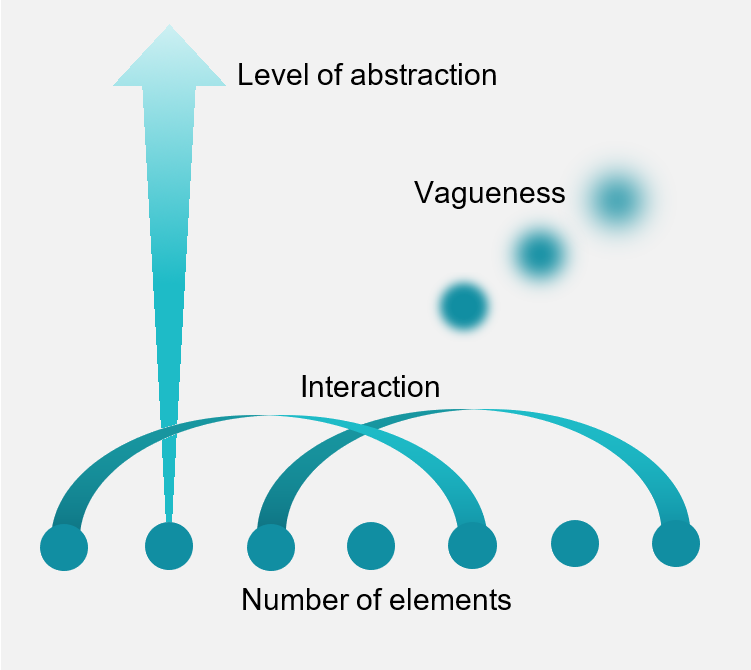
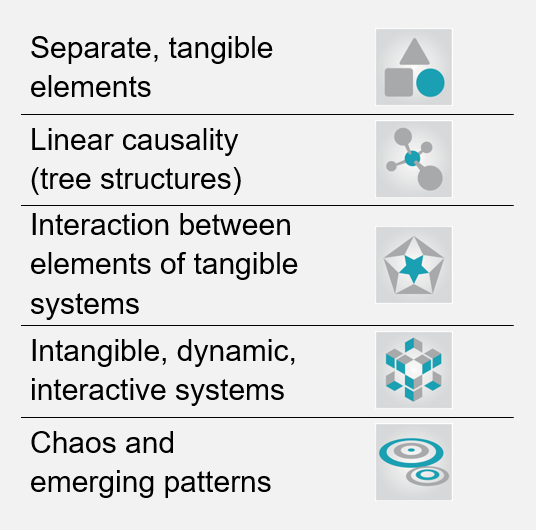
The above aspects of complexity are present in varying degrees in each of the five units of information, which include:
- Separate elements
- Linear causality
- Tangible systems
- Dynamic and interactive systems
- Chaos and emerging patterns
The units of information are also structured holonically in that more complex units of information incorporate and transcend preceding units. For example, “Linear causality” includes “Separate elements”, but also transcends it. “Tangible systems” includes “Linear causality” and “Separate elements” but also transcends both, etc.
The units of information involved in the levels of work complexity
Once Prinsloo unpacked cognitive complexity and identified the five units of information as an indication of a person’s complexity preferences and capabilities, the next logical step was to link human capability to levels of work complexity. Here, she capitalised on Elliott Jaques’s Stratified Systems Model (SST) and Stafford Beer’s Viable Systems Model (VSM). The outcome of this process will be given in “Applications within the work environment” section.
The development of a cognitive assessment methodology
As part of a PhD thesis, Prinsloo (1992) proposed and validated a unique self-contained theoretical model of thinking processes, the IPM. She proceeded to develop a methodological approach for the operationalisation, externalisation and tracking of thinking processes to enable the design of thinking process assessments. The technique involves a thinking process simulation.
This was followed by the creation of the Cognitive Process Profile (CPP) assessment, which is an automated simulation exercise that externalises and tracks the operationalised IPM thinking processes in great detail, in tenths of seconds and according to thousands of measurement points. The results are analysed by an algorithmic expert system.
The design of the Cognitive Process Profile (CPP) is primarily based on three sources of information on cognitive functioning and its assessment, including: an in-depth literature survey and critical review of a wide range of contributions within the field of intelligence research; the intuition of the developer; and thorough action research on how diverse individuals and groups solve problems, reason, conceptualise their understanding and act on such insights.
Prinsloo found the Differential approach to the measurement of cognition, or conventional Intelligence Quotient (IQ) testing particularly limited, especially its cross-cultural bias. With the development of the CPP and LOI, she therefore relied on design features that address the inadequate applicability, test bias and adverse impact associated with ability tests given their
- content specific nature, the knowledge required and the educational loading involved;
- their exclusive logical-analytical reasoning requirements;
- the timed nature of IQ tests;
- the decontextualised or disembedded nature of the item content; and
- the absence of a theoretical model by which a wide range of cognitive approaches to problem solving, reasoning and conceptualisation can be accommodated.
Other cross-cultural factors were also addressed, such as those of an emotional and motivational nature as well as the values which impact on cognitive functioning. Examples of the latter include the discouragement of both quick responses and critical thinking in certain cultural contexts.
Prinsloo, however, noticed the differences in cognitive functioning between various generations. She proceeded to develop the Learning Orientation Index (LOI) for younger candidates – particularly school and university leavers, or the age group of 16 to 30. Although the tasks involved in the CPP and LOI differ fundamentally, both tools are based on the IPM and the results of the two tools are comparable.
The CPP and LOI thus measure the same thinking processes in very different ways. The CPP in particular, and the LOI to some extent, do not require correct answers or the application of a specific cognitive style. The assessments are not timed although the cognitive activities are measured in tenths of seconds to indicate constructs such as Speed, Quick Insight, Pace Control and Quick Closure. Very few processing scores are, however, impacted by speed-related factors. The focus of the CPP and LOI remains on the test candidate’s preferences and capabilities in information processing. These aspects include the measurement of cognitive complexity and learning potential. Detailed reports are automatically generated to support selection, placement and development decisions and initiatives.
The CPP and LOI techniques introduced a new paradigm to cognitive assessment which transcends the limited, linear, domain-specific ability measurement techniques as well as some of the shortcomings of alternative approaches including assessment centres, structured interviews and “game” assessments.
Applications within the work environment
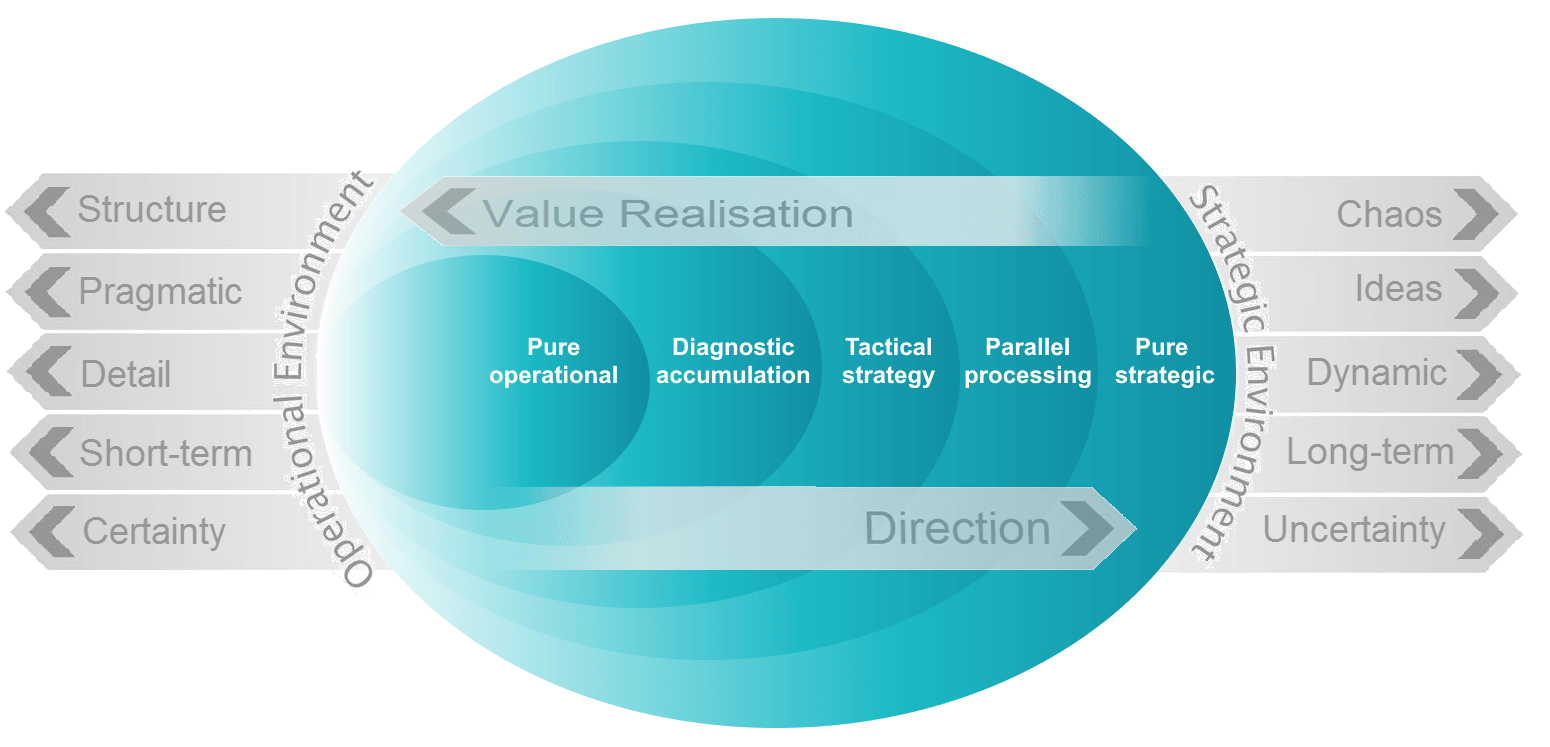
Cognitive complexity as measured by the CPP and LOI, lends itself perfectly to the matching of people capabilities to work requirements. For this purpose, and to address the interface between people skills and work complexity, Prinsloo adapted the hierarchical SST and the recursive VSM to correspond to the holonic IPM model. The proposed integrated IPM of work complexity consists of five levels of cognitive functioning, or work requirements, which are organised holonically. The levels of work complexity range from Pure Operational to Pure Strategic work. Whereas operational work is clearly structured and tangible in nature, strategic work is ideas-based, intangible and dynamic in nature.
The IPM thus measures people’s information processing competencies and learning potential which inform the specific cognitive requirements of work. It is aimed at optimising the depth and quality of person-job matching and work performance predictions.
For IPM purposes, the units of information that a person prefers and shows capacity to deal with can almost directly be linked to the level of work complexity in which they feel comfortable or “in flow”. The five levels of work complexity, which integrate the SST, VSM and the IPM, are:
- Pure Operational work, which involves dealing with separate, tangible elements in highly structured and routinised practical contexts
- Diagnostic Accumulation work, which involves investigation and linear causal reasoning capitalising on knowledge and experience in operational environments
- Tactical Strategy work, which comprises of management and professional work within tangible operational systems
- Parallel Processing work, focusing on the integration of complex, dynamic, interactive and fuzzy systems
- Pure Strategic work, interpreting and predicting emerging patterns within complex and chaotic environments
A graphic representation of the proposed IPM work complexity model appears below:
In addition to the unit of information preferences and capabilities, a person’s suitability for optimal cognitive functioning within a particular work environment, as calculated by the CPP report, is also informed by their:
- cognitive style or stylistic preferences;
- certain work-related preferences and capabilities (namely a focus on detailed versus dynamic complexity, tangible versus intangible information, short term versus long term applications, and structured versus unstructured contexts); as well as
- a person’s judgement capability.
For over a quarter of a century, the IPM, and the associated assessment methodologies, have been a fundamental part of Cognadev’s holistic approach to selection assessments, job matching and people development in organisations.
Prinsloo has also developed the Contextualised Competency Mapping (CCM) tool for job analysis in terms of cognitive complexity, processing requirements as well as the broader holistic competency requirements of a role or a position. The Integrated Competency Report (ICR) is a holistic report which integrates multiple assessment results with the competency requirements of a role or position. An ICR sample report can be downloaded here.
Research
Through the years, Cognadev has developed a body of research evidence for the validation of the CPP and the LOI. The research manuals that detail these findings are available from Cognadev in printed form. Summarised versions are available in the CPP and LOI eLearning courses (which are required for qualifying as an accredited user). Further studies are published as a Technical Report Series and some as blogs on the Cognadev website and the Cognadev assessment delivery platform.
Useful links
This blog is part of a series on models of work complexity, which includes “What is the Stratified Systems Theory (SST)?”, “What is the Viable Systems Model (VSM)?” and “Models of Work Complexity: a comparison of the SST, VSM and IPM”.
Descriptions of the Cognitive Process Profile (and a sample report), the Learning Orientation Index and Cognadev’s Technical Report Series can be found on Cognadev’s public website.
“How to Think” explains information process competencies in layman’s terms and provides examples of the application of metacognitive criteria to enable effective thinking and problem-solving.
“Cognition: theory, measurement, implications” is a useful and in-depth article which explains the history of intelligence research and the development of the CPP and LOI assessment techniques.
References
Prinsloo, S. M. (1992). A theoretical model and empirical technique for the study of problem solving processes. PhD, RAU, Johannesburg.
Prinsloo, S. M. & Barrett, P. (2013). Cognition: theory, measurement, implications. Integral Leadership Review.